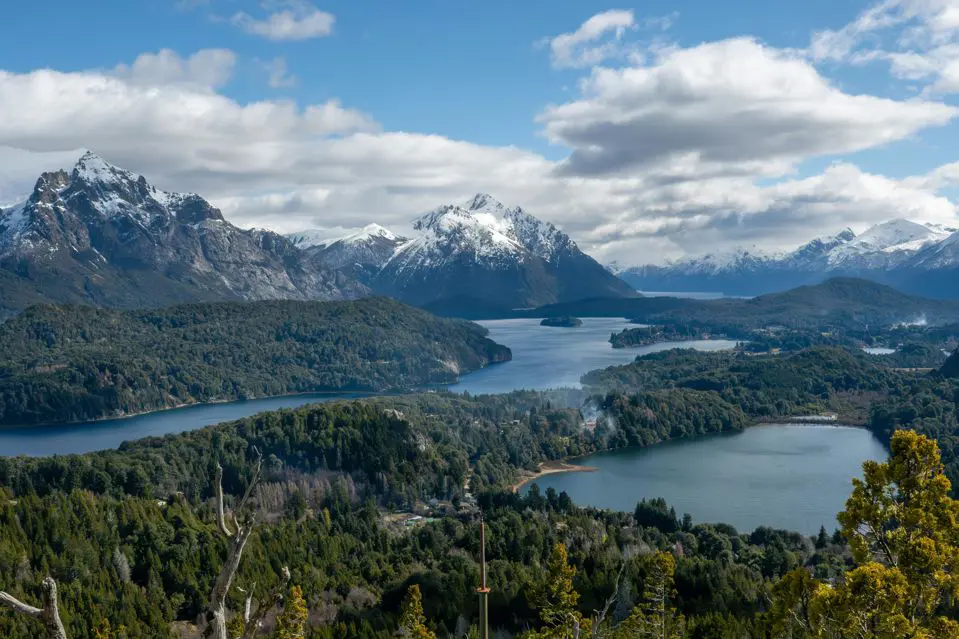
The Circuito Grande (Big Circuit) of Bariloche is one of the most beautiful tours in the region, and one of the most complete to know the Patagonian essence. Its name is due to the fact that, unlike the famous Circuito Chico, this one covers about 250 kilometers. Strictly speaking, it is taken because it combines extraordinary viewpoints and approaches to mountain towns, lakes, and many other attractions. Undoubtedly, it is one of the most beautiful roads on National Route 40. And one of the simplest, as it is a circular circuit: it starts and ends in San Carlos de Bariloche. Now, where does it start and where does it end? What is the best way to do it? We break it down in this article.
According to indications from the local Tourism Secretariat, the Circuito Grande of Bariloche starts and ends as follows:
- Start: San Carlos de Bariloche (generally from the center or from Av. Bustillo, heading west).
- Route: Bariloche, Villa Llao Llao, Colonia Suiza, Puerto Villegas Peninsula, Confluencia, Villa Traful, Villa La Angostura, Route of the Seven Lakes, and return to Bariloche.
- End: San Carlos de Bariloche (same starting point).
The big circuit of Bariloche takes between 8 and 10 hours, if done with rests and stops at the main attractions. Below, we tell you what they are and why they are worth knowing.
How to Do the Circuito Grande of Bariloche
If the doubt is how to do this circuit without having a car or your own vehicle, the answer is with a safe and complete tour to Villa La Angostura through Circuito Grande. Best Bariloche Tours offers a program with which, in about 10 hours, you will do the entire route indicated above from the city of Bariloche to Villa La Angostura, passing through the Limay River Amphitheater, the charming Valle Encantado, and the junction of the Traful and Limay rivers.
This possibility is excellent also because it includes transfer from your accommodation, expert guides who will offer details of each region, stops to take photos at strategic points, and time to walk in Villa La Angostura. Although lunch is not included, you can enjoy the varied offer of restaurants in the towns and cities, and at the end of the day, you will return with many charming memories.
The Circuito Grande is a synthesis of southern Argentina. For those visiting Bariloche for the first time, it is an ideal way to understand the magnitude of Nahuel Huapi National Park; for those returning, it is an opportunity to reunite with a vast, silent, and always different Patagonia.
Llao Llao Peninsula: The Start of the Circuit
The tour usually starts from Avenida Bustillo, heading west, where the emblematic landscape of Bariloche quickly appears: the Llao Llao Peninsula, embraced by lakes Moreno and Nahuel Huapi. In this first section, forests of coihues, cypresses, and arrayanes are appreciated, along with the cutout views of mounts López, Capilla, and Millaqueo. The emblematic Llao Llao Hotel is also appreciated, where everyone from presidential figures to international stars stay. Quiet bays with blue waters and boats departing from Puerto Pañuelo to Victoria Island and the Arrayanes Forest complete the image.
Colonia Suiza
Deviating via provincial route 79, a few minutes from Llao Llao, appears Colonia Suiza, one of the corners with its own identity within Bariloche. Founded in the late 19th century by families from the Swiss Valais, this corner maintains an alpine aesthetic recognized in wooden architecture, flowery gardens, and community organization.
Upon arrival, you can walk its streets and stroll through artisan fairs, taste regional products, and witness the curanto, a Mapuche-Huilliche cooking method adopted by the settlers and cooked in a pit with hot stones. The ceremony attracts tourists throughout the year and is part of the area's cultural heritage. Colonia Suiza is also an access to short trails and natural viewpoints, ideal for those seeking to combine tradition and nature.
The Limay River Valley
Resuming national route 231 heading northeast, the lush forest characteristic of Bariloche is left behind, and you encounter the Patagonian steppe. It is an abrupt change that surprises: in a few kilometers, humid green transforms into ochre tones, rock formations, and a drier environment. Here appears the Limay River Valley, one of the most photographed landscapes of the Circuito Grande.
The Limay winds between cliffs and canyons, and its color—sometimes turquoise, other times emerald—contrasts with the aridity of the steppe. El Anfiteatro, a semicircular rock formation, is a mandatory stop to contemplate how wind and erosion shaped the stone walls for years until turning it into what it is. Whimsical shapes and light plays at different times of the day make the valley an always different scenario.
Along this stretch, there are several signposted viewpoints and areas where it is possible to stop to take photos, walk a few minutes, or simply enjoy the silence. For those traveling with time, the valley offers opportunities for bird watching, sport fishing, and small hikes to natural viewpoints.
Confluencia
The name Confluencia alludes to the point where the Traful and Limay rivers join, a point of enormous scenic beauty and ecological value. The mixture of both currents generates a visual spectacle that changes according to the time of year, flow, and light. This sector marks a turning point in the tour: from here, the route re-enters the wooded area on the way to Villa Traful.
During the journey, hills, stone walls, and pebble beaches are observed. For this and more, the crossing known as Confluencia is a destination appreciated by photographers and travelers seeking less frequented corners. It is also a treasure for fishermen, who take advantage of the variety of Patagonian rivers. It is also a good place to take a quiet break before continuing to one of the most charming towns on the circuit.
Villa Traful
After entering the national park again, the route becomes more winding and surrounded by dense forests until reaching Villa Traful, a small town on the shores of the lake of the same name. Due to its mountain houses, leisurely pace, and family atmosphere, Traful is known as a luxury and rest destination for those seeking nature in its purest state.
The great attraction is the Mirador del Traful (Traful Viewpoint), a walkway built on a cliff more than 70 meters high offering a panoramic view of the lake and surrounding mountains. From this point, the deep blue of the lake combines with the texture of native forests and the imposing presence of cliffs. Another undisputed attraction is the Bosque Sumergido (Submerged Forest), a set of petrified trees underwater that can be appreciated on lake excursions or by diving.
Villa Traful also has beautiful beaches to cool off during summer, or to practice kayaking and diving. It also has simple trails to explore autonomously, and gastronomic proposals rescuing local products such as trout, red berries, and craft beer. It is an ideal place to stop for lunch or spend a few hours exploring.
The Route of the Seven Lakes
From Traful, the Circuito Grande continues north and joins National Route 40, in one of its most famous segments: the Route of the Seven Lakes. This road, considered one of the most beautiful in the country, connects crystal clear lakes, elevated viewpoints, and forests of coihues, lengas, and ñires. Lakes Correntoso, Espejo, Falkner, Villarino, Machónico, Lácar, and Escondido draw an impressive tour of colors, aromas, and sensations.
Villa La Angostura
The circuit then reaches Villa La Angostura, one of the most elegant and neat towns in Patagonia. Its two main bays, Bahía Brava and Bahía Mansa, offer calm waters, photogenic piers, and views of Nahuel Huapi changing according to the time of day. From the port, excursions depart to the Arrayanes Forest, a unique site in the world due to the concentration of these cinnamon-barked trees.
La Angostura also invites touring its center, enjoying chocolate shops, craft breweries, and restaurants working with regional products. It is a perfect point to rest after several hours of travel before resuming the route to Bariloche.
The final stretch of the Circuito Grande follows RN 40 and RN 237, bordering Nahuel Huapi again and gradually returning to the best-known landscape of Bariloche.
Published by Has Chacon on 08/06/2026