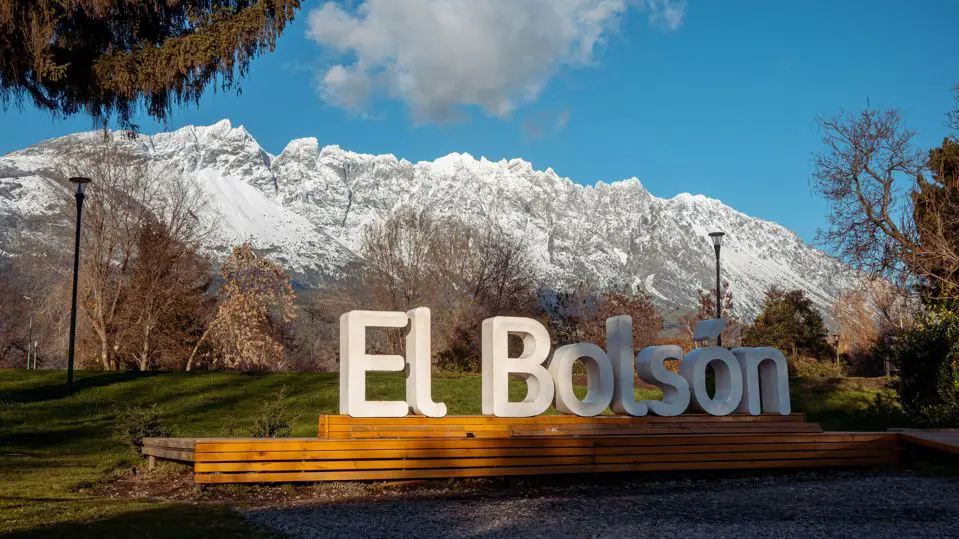
Spending the day in the town of El Bolsón (Río Negro province) has become a classic trip in southern Argentine Patagonia for those "basing themselves" or booking accommodation in San Carlos de Bariloche, the nearest city. It’s not that the latter lacks natural landscapes or cultural proposals to enchant visitors, but this particular spot, hidden almost at the border with the province of Chubut in the micro-region known as the “Andean Comarca of the 42nd Parallel,” never ceases to surprise and make its visitors fall in love.
road to El Bolsón from Bariloche
There are several ways to travel from Bariloche to El Bolsón to spend the day. If you have your own vehicle, just take Route 40 south. The road is simple and safe, with impressive views of the Andes. In winter, it is advisable to check the weather conditions, as frost may occur.
Another widely used option is the bus from Bariloche to El Bolsón. They leave from the Bariloche Bus Terminal every one or two hours, with different companies (Las Grutas, Via Bariloche, among others). Tickets can be bought online or at the ticket office, and the cost varies by season. It is an economical and comfortable alternative, ideal for those who do not want to drive.
However, the most practical and complete way to do the tour, especially if you have little time, is to book a full-day excursion.
Unmissable tour to El Bolsón
Best Bariloche Tours offers an excursion to El Bolsón from Bariloche designed especially for a day without worrying about logistics. The tour includes round-trip transfers, a bilingual guide, and stops at the most emblematic points of the Andean Comarca.
The itinerary usually starts early in the morning, taking Route 40 south. On the way, stops are made to appreciate the natural viewpoints and enjoy a coffee overlooking Lago Mascardi. Upon arriving in El Bolsón, the group tours the Artisanal Fair, the town center, and the surroundings of Cerro Piltriquitrón, with free time for lunch and visiting artisans' workshops.
In the afternoon, the excursion continues to Lago Puelo, inside the National Park of the same name, located in the province of Chubut. This turquoise water lake, surrounded by mountains covered with Valdivian forest, is one of the most photogenic landscapes of the southern Andes. There you can walk along the beach, take a short boat ride, or simply contemplate the reflection of the hills in the water before starting the return to Bariloche.
The full excursion lasts about ten hours and is ideal for those seeking an organized experience, with professional accompaniment and without worrying about driving or schedules.
Culture, History, and Community of El Bolsón
El Bolsón has a unique history within the Patagonian map. It began as an agricultural and livestock town, but in the 1960s and 1970s, it received an influx of artists, artisans, and seekers of an alternative life who, however cliché it may seem, found in this fertile and protected valley “a place to start over.” Thus emerged the identity that still distinguishes it today: a combination of art, ecology, and spirituality.
The community maintains a spirit of solidarity and cooperation represented in every corner of the town. There are producer cooperatives, cultural workshops, and a strong environmental movement working to preserve the rivers and forests of the Río Azul – Lago Escondido Natural Protected Area (ANPRALE), a huge territory preserving native forests of coihues, lengas, and cypresses, containing a network of trails and mountain shelters that are a hiker's paradise.
In recent years, sustainable tourism has become one of El Bolsón's main sources of income, with ventures prioritizing low environmental impact and respect for biodiversity. Those visiting the town for the day are often surprised by the tranquility in the air and the hospitality of its inhabitants.
In short, El Bolsón is one of the most sought-after towns for tourism in Patagonia due to the huge variety of activities you can do in a day amidst truly beautiful natural landscapes. One of the best times is February, when the summer heat invites organizing many outdoor plans, and when the National Hop Festival is celebrated. The city is renowned nationwide for its hop production, the main ingredient in beer and the key to its flavor. And of course, summer and beer go perfectly hand in hand, becoming even more vibrant with live music and shows.
However, El Bolsón is a destination that can be visited at any time, as besides having a pleasant climate for much of the year (especially between September and April), various activities can be done according to the style and tastes of each visitor.
What to Do in a Day in El Bolsón: Trails, Shelters, and Nature
If you only have one day, a great option is to go up Cerro Piltriquitrón (which in Tehuelche means “hanging from the clouds”), the distinguished peak of this region. Locals simply call it “el Piltri.” Its silhouette dominates the horizon, and its trails offer short hikes with impressive viewpoints. About 11 kilometers from the center, via a gravel road, is the access to the Bosque Tallado (Carved Forest), an open-air art gallery with more than 60 sculptures carved in wood by artists from different parts of the world on tree trunks burned by old fires. It is one of the most emblematic places for those looking for a short but unforgettable walk.
Another option is to take a short hike on one of the ANPRALE circuits. One of the most popular is the one leading to the Cajón del Azul, a hidden corner where the river, of an almost unreal turquoise color, is encased between rock walls. From downtown El Bolsón, you can access Wharton by vehicle (about 13 km) and start the trail from there. The initial section is of medium difficulty, but the effort is worth it: the landscape is one of the most striking in all of Andean Patagonia.
In the area, there are also mountain shelters where you can have lunch or a drink before heading back. The best known are Refugio Cajón del Azul, Refugio La Playita, El Retamal, Hielo Azul, and Encanto Blanco, among others.
For those traveling for the day from Bariloche, a good alternative is to visit one of the shelters closest to the start of the trails, enjoy a homemade lunch, and then return in the afternoon. The surroundings, the sounds of the forest, and the clarity of the river create an experience difficult to forget.
Another unmissable classic of El Bolsón is the Regional Artisanal Fair, one of the largest and oldest in the country. It was born in the 70s as a meeting point for artisans, organic producers, and artists, and over time became the cultural heart of the town. It is set up three times a week (Tuesdays, Thursdays, and Saturdays) at Plaza Pagano, the city's central green space.
Weavings, ceramics, knives, jewelry, instruments, sweets, liqueurs, baked goods, and many other handmade creations are offered. There are also food stalls and live music, transforming the walk into a true popular celebration. For many tourists, the fair is the soul of El Bolsón, a reflection of the cooperative and alternative spirit that has characterized the area since the 60s when the first hippie and agricultural communities began to settle.
After touring the fair, it is worth taking a break at one of the bars or craft breweries in the center. Thanks to the water quality and the hop-growing tradition, El Bolsón has several recognized craft beer brands, including Patagonia, Piltri, Otto Tipp, Lupulus, Parapapoto, and El Bolsón, the most traditional.
Some bars also offer live music, homemade food, and a relaxed atmosphere, ideal for enjoying the sunset before returning to Bariloche. In summer, the sidewalks are full of life, and the aroma of hops and baked bread mixes with the mountain breeze.
For the more curious, there are also gastronomic circuits that include visits to organic farms, where you can taste fine fruits (raspberries, cherries, blackberries), sweets, and artisanal honey. Several local families open their doors to visitors and offer products made with sustainable techniques, the heritage of a community that has always defended simple living and respect for nature.
El Bolsón from Route 40
National Route 40, one of the most mythical in Argentina, connects Bariloche and El Bolsón over about 120 kilometers. The road, completely paved and well-signposted, winds through forests, lakes, and mountains, allowing stops at natural viewpoints, rivers, and mountain rest stops.
Highlights of the journey include Lago Gutiérrez, Cascada Los Alerces, Lago Mascardi, the El Foyel area, and the small settlement of Villegas, before reaching the destination. The entire route is a living postcard of the Patagonian landscape, with cypresses, coihues, and the intense blue of the lakes accompanying the road.
Those wondering how many kilometers there are from Bariloche to El Bolsón should know that the exact distance is around 120 km, and the trip takes about two hours by car or bus, depending on the stops.
How is it to Spend a Day in El Bolsón
To make the most of the day, it is ideal to leave Bariloche early, between 7 and 8 in the morning. On the way, brief photographic stops can be made on Route 40, especially at the viewpoints overlooking the Villegas River valley.
Once in El Bolsón, the first recommended point is Cerro Piltriquitrón. If the weather permits, you can drive up to the base of the trail and do the short walk to the Bosque Tallado. The views of the valley and the Quemquemtreu River are spectacular, and if you continue a little higher, you reach the Piltri shelter, where it is possible to have something hot or a craft beer overlooking the snowy peaks.
Back in town, the Artisanal Fair is a must-visit. It is advisable to have a quick lunch there—empanadas, small pizzas, trout, or homemade tarts—and then continue to the surroundings. If time permits, you can visit a production farm or make a getaway to Lago Puelo, just 15 minutes by car.
For those who prefer hiking, the walk to Cajón del Azul is an incomparable alternative, although it requires a bit more time and energy. In that case, it is recommended to start early and return in the mid-afternoon to be back in Bariloche at dusk.
What is the Distance Between Bariloche and El Bolsón
The distance between Bariloche and El Bolsón is about 120 kilometers via Route 40 Bariloche – El Bolsón, which is equivalent to approximately two hours of travel. The road is completely paved and can be done by private car, bus, or excursion. In public transport, schedules are frequent throughout the year, although in winter they may vary according to weather conditions.
The Bariloche – El Bolsón route is, in itself, a tourist attraction. It combines mountain landscapes, forests, and glacial lakes, and in some sections, condors or deer can be seen crossing the road. It is a journey that many travelers consider part of the experience, inviting stops at various panoramic points before reaching the destination.
Published by Has Chacon on 08/06/2026