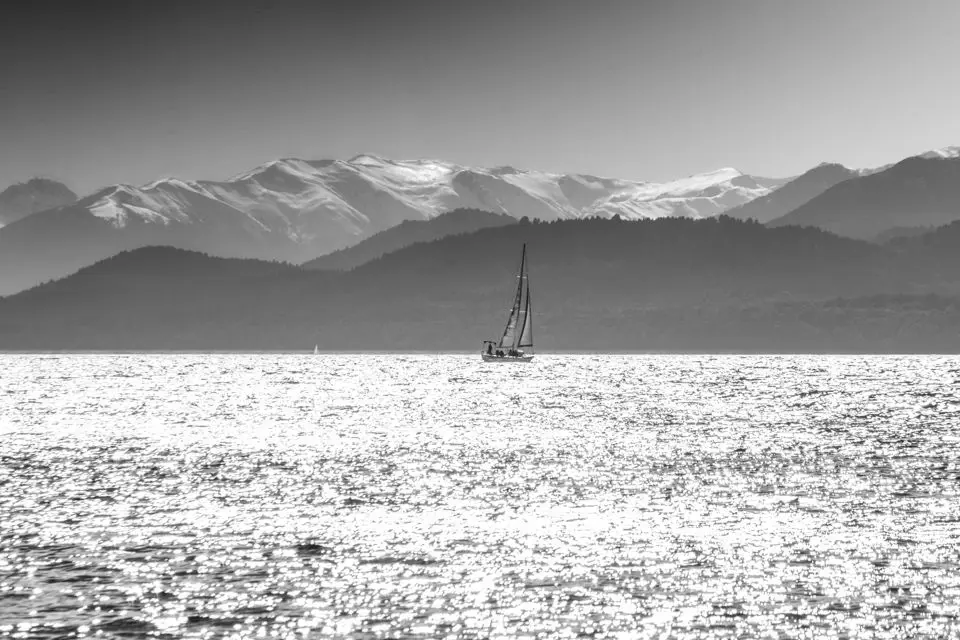
Navigating Lake Nahuel Huapi is one of the most sought-after tourist attractions in Bariloche, the Patagonian city that from its ports allows embarking towards multiple destinations and adventures. From the moment you step onto a boat deck or mount a kayak, the skin feels the tingling of adrenaline and fun about to emerge. How not to be moved by the wonderful view of the Bariloche landscape from inside the lake? The water in dark blue, turquoise, and petrol green tones, snowy mountains as a backdrop, green and dense forests in their splendor. Navigating is an experience transforming any trip to Bariloche because it offers a different perspective: hills rise even more imposing, forests look endless, and coasts reveal secret bays and beaches inaccessible from the mainland.
In recent years, lake excursions have multiplied and diversified. Today it is possible to navigate Lake Nahuel Huapi by catamaran, sailboat, fishing semi-rigid, or even paddling in a kayak towards its wildest and most isolated arms. Each activity responds to a type of traveler and a very personal way of connecting with this landscape protected within Nahuel Huapi National Park. From those seeking a contemplative and quiet day to those wanting adventure and adrenaline, the lake offers a gateway to all possible rhythms.
If you want to know how to navigate Nahuel Huapi and which of all experiences best suits your itinerary, budget, and desire, we invite you to read these proposals from Best Bariloche Tours.
Great Catamaran Navigation to Victoria Island and the Arrayanes Forest
Among all lake experiences, the classic par excellence is the navigation in catamaran from Puerto Pañuelo towards Victoria Island and the Arrayanes Forest, an excursion combining landscape, biodiversity, and a share of natural history unique in the country. The tour begins by crossing a wide section of the lake, where waters are usually calm and the immensity of this glacial origin basin is appreciated. Little by little, Victoria Island appears on the horizon with its forests, hidden beaches, and trails inviting to walk.
The guided walk on the island is, without a doubt, one of the most valued points. Here native species mix with others introduced in the early 20th century, such as pines, birches, and redwoods, coexisting with coihues, ñires, and Patagonian cypresses. It is also frequent to see birds, traces of small mammals, and even old trees telling the island's history as an experimental forest nursery. After the tour, the catamaran continues to the Quetrihué Peninsula, where the famous Arrayanes Forest is located, a site captivating any visitor: cinnamon-colored trees, cold and smooth barks, twisted shapes, and an atmosphere that seems from another tale.
The excursion is especially enjoyed because it is suitable for all types of travelers: families, seniors, groups of friends, or those wanting to dedicate a whole day to exploring two Patagonia classics. The navigation is stable, includes guide and transfers, and allows anyone to soak up the magic of these forests without worrying about logistics. It is the most complete option for those seeking a first approach to the lake.
Sailboat Rides: Navigating Nahuel Huapi to the Rhythm of the Wind
At the other end of the spectrum is the sailboat ride through Nahuel Huapi, a more intimate, silent, and relaxed activity. Unlike the catamaran, the sailboat moves to the rhythm of the wind, without haste and without engine noise. The experience generally begins at Puerto Petunia and follows a route through Brazo Campanario, an area where mountains approach the water's edge and deep, quiet bays form.
During the three hours the ride lasts, the landscape constantly changes: Neuquén coasts appear in the distance, Huemul and De los Víveres islands are observed, and hidden beaches alternate with natural viewpoints. The navigation also allows seeing the water color from very close, a mixture of dark blue and bright green becoming even more intense on clear days.
Each sailboat navigation invites a different sensory connection with the surroundings. The captain usually gives the possibility of participating in the boat's maneuver, taking the helm, or just relaxing while the wind does the work. Snacks and hot drinks complete an experience designed for those seeking a quiet, romantic, or simply contemplative ride. It is ideal for couples, people wanting to avoid crowds, or those wishing to enjoy Nahuel Huapi in a slower version.
Sport Fishing: Navigation to Seek Trout in Cold and Crystal Clear Waters
Nahuel Huapi is also fisherman territory. Its waters harbor rainbow, brown, and brook trout, making the lake and its close brothers (Moreno and Gutiérrez) one of Patagonia's most important sport fishing destinations. Half-day excursions combine navigation in semi-rigid boats with techniques like fly fishing, spinning, or trolling, according to the traveler's taste. This variety allows both experienced fishermen and beginners to enjoy the experience under the guidance of authorized instructors.
The semi-rigid allows reaching corners where fishing from the coast would be impossible. Deep waters, protected bays, and areas where currents mix give rise to an ideal ecosystem for catch and release. Full equipment—rods, lures, flies, waders, vests—is included, so the outing is fully accessible to someone who has never fished.
Another option for those seeking a longer day and a quieter experience is trolling fishing in Nahuel Huapi. This activity usually departs from Bahía López and allows exploring different sectors of the lake depending on the weather. Brazo Tristeza, the Blest area, or even the surroundings of Victoria Island are usually common destinations. Navigation is slow, designed to accompany the tackle's movement, and the guide takes care of reading the lake like an open book. In addition, the experience is completed with a regional lunch on board, with smoked goods, cheeses, empanadas, and Patagonian wines.
Fishing is, for many, a ritual, a moment of calm and patience. Navigating in search of trout, in that silence surrounded by mountains, is a very different way of knowing Nahuel Huapi.
Kayak in Brazo Tristeza: Adventure, Deep Nature, and Silence
Kayaking probably offers the wildest and closest experience to the Nahuel Huapi landscape. Paddling is direct contact with water and the lake's natural rhythms, without engines or structures. Among the most recommended destinations is Brazo Tristeza, a corner of Nahuel Huapi known for its wilder geography, high mountains sinking into the water, and waterfalls falling from the Valdivian forest.
The full-day kayak tour on Brazo Tristeza usually departs from Bahía López and continues along the arm until entering little-traveled sectors. The guide sets the pace, explains basic paddling techniques, and accompanies groups throughout the day. Stops are made at hidden beaches only reachable from the water, lunch is had facing the mountain range, and if the weather accompanies, you get to see some of the waterfalls descending from the hills.
It is an ideal outing for those seeking full nature and moderate physical activity, without reaching the demand level of a crossing. Brazo Tristeza retains an aura of isolation and mysticism not found in other sectors of the lake, and kayaking allows experiencing it in an intimate and silent way.
Kayak in Brazo Campanario: An Accessible Alternative for Beginners
For those wanting to paddle but preferring a shorter and accessible experience, kayaking in Brazo Campanario is the ideal option. With an approximate duration of three hours and a first instance of instruction, this activity is perfect for those who have never kayaked or for families with teenagers. The tour allows exploring small beaches, seeing hills López, Catedral, and Otto from the water, and enjoying a sector of Nahuel Huapi combining beauty with tranquility.
Instructors authorized by Prefecture and National Parks guarantee safety and accompaniment, and professional equipment makes anyone feel comfortable in the water, even if it is the first time. Brazo Campanario also usually offers more stable and less windy conditions than other parts of the lake, making navigation more bearable.
Kayak at Huemul Island: Rowing, History, and Imposing Geography
Another fascinating alternative is kayaking at Huemul Island, an excursion combining aquatic adventure with local history. Navigation around the island allows observing rocky walls reaching 40 meters high inside and outside the water, an imposing landscape accounting for the region's volcanic and glacial origin. The water here has a special color, a product of the contrast between depth and proximity of rocks.
In addition to rowing, the activity includes a trekking to the ruins of the Huemul Atomic Project, a story as incredible as real: in the 1950s, scientist Ronald Richter tried to develop nuclear energy on this island, in an experiment seeking to transform Argentina into a world pioneer. Today, the ruins are toured as a reminder of that excessive ambition.
The combination of landscape, history, and physical activity makes this excursion one of the most complete for those seeking something original and different from traditional walks.
Public Beaches of Nahuel Huapi: Mate, Rest, and Summers by the Lake
In addition to excursions, Nahuel Huapi offers numerous free beaches to enjoy at no cost, ideal for resting, drinking mate, reading a book, or even taking a dip during summer. Among the best known is Playa Bonita, located at kilometer 7 of Avenida Bustillo: a pebble beach, with transparent waters and typical seasonal movement, ideal for spending the afternoon.
Further on appears Bahía Serena, a small bay sheltered from the wind and with a gentle entry to the water, very popular with families. Another option is Playa del Centenario, closer to the center, with views of Cerro Catedral and a more local atmosphere, especially at sunset. The lake coast is also enjoyed at Playa Melipal, Playa del Viento—highly chosen by windsurf and kitesurf lovers—and in sectors near Villa Tacul, where forest and water meet in a wilder way.
In summer, Nahuel Huapi beaches are a mandatory plan for those seeking an economical and relaxed day, with the unmistakable charm of the lake and its icy waters. Although cold, the waters attract locals and tourists daring to swim, snorkel, or simply cool off after a walk.
Published by Has Chacon on 08/06/2026